

Looking for the best time to send marketing emails? We’ve analyzed data from billions of emails to find the optimal send times that actually drive opens and clicks. The surprising truth? Morning isn’t always best—and AI might know your audience better than any schedule. Here’s what the data says and how to apply it.
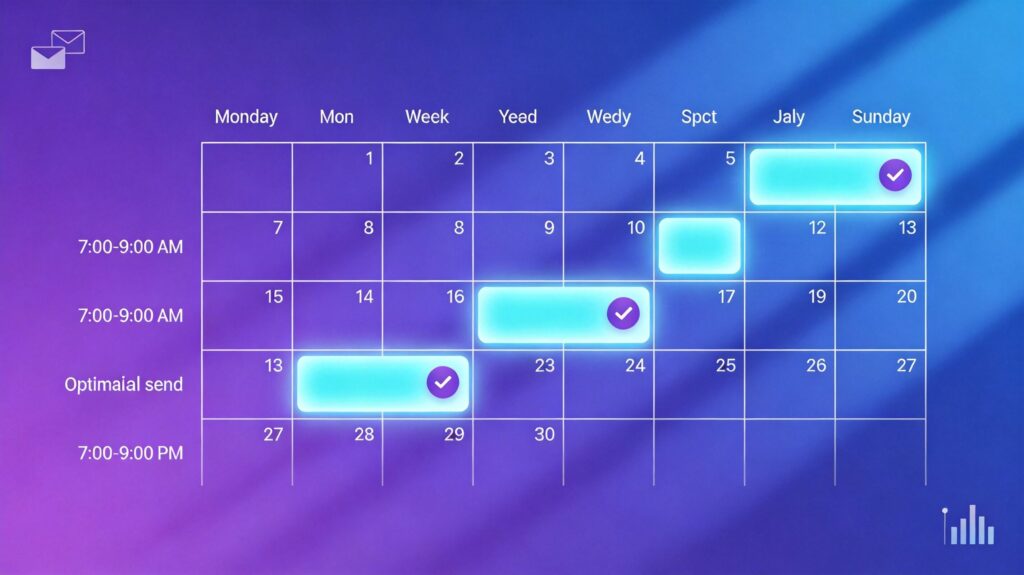
Every marketer has asked it: “What is the best time to send marketing emails?” The answer matters more than you might think. An email sent at the wrong moment gets buried. The right timing? It can double your open rates overnight.
But here’s the thing—there’s no universal answer. The best time to send depends on your audience, your industry, and what you want them to do. Let’s break down what the data actually shows.
What the Data Says About Email Send Times
After analyzing billions of emails, the data tells a clearer story than most blog posts admit:
- Best day: Tuesday, Wednesday, and Thursday consistently outperform other days
- Best time for opens: Mid-morning (10 AM) in your recipient’s time zone
- Best time for clicks: Evening (8-9 PM)—yes, seriously
- Worst days: Saturday and Sunday show the lowest engagement for most industries
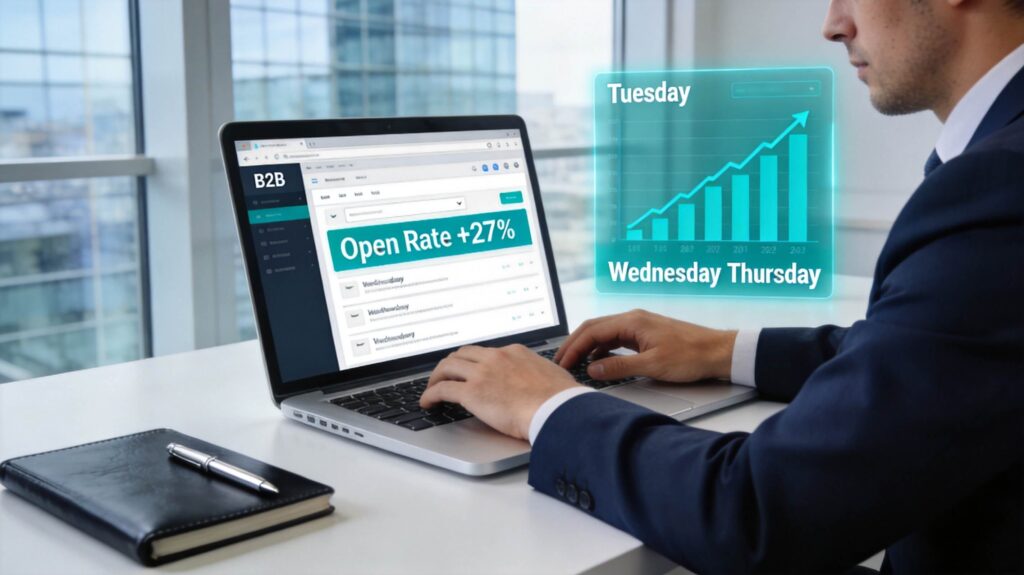
According to HubSpot’s 2026 research, 27% of US marketers report Tuesday as their highest engagement day. But here’s the plot twist: if you want clicks (not just opens), evening sends often win.
Best Time to Send Marketing Emails by Audience Type
Not all audiences behave the same. Your subscribers’ habits depend on whether they’re checking work emails or personal ones.
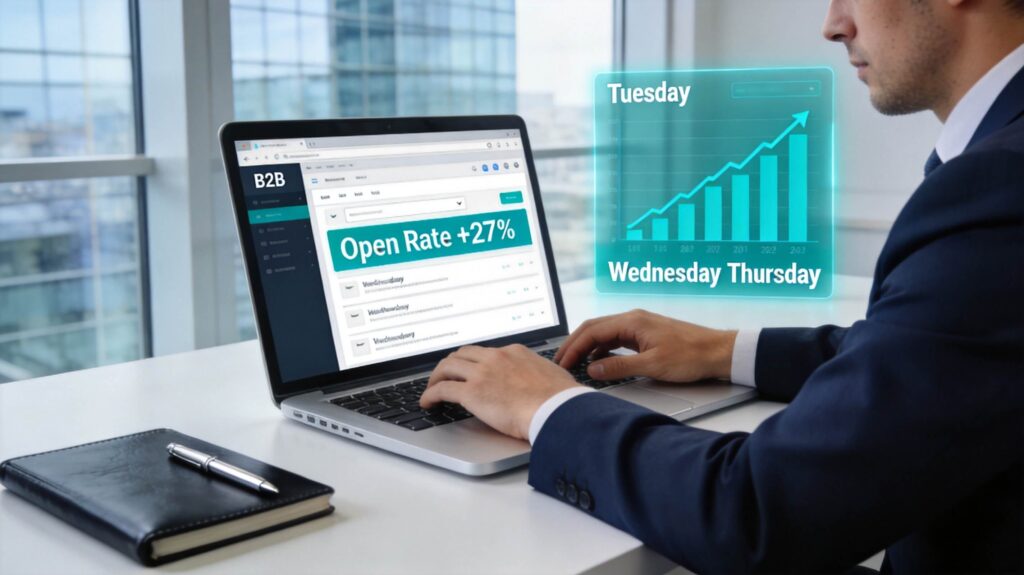
B2B: When Your Audience is at Work
Business-to-business emails hit different inboxes—people juggling meetings, deadlines, and overflowing inboxes.
Best times for B2B:
- Days: Tuesday through Thursday
- Time: 9 AM to 11 AM, or 12 PM to 1 PM (lunch break)
- Avoid: Monday mornings (inbox overload) and Friday afternoons (weekend mode)
B2B professionals open emails to gather information. They click through when they have bandwidth—often during lunch or after clearing urgent morning tasks.
B2C: When Your Audience is Relaxed
Consumer emails land in personal inboxes. The rules change completely.
Best times for B2C:
- Days: Thursday through Sunday often perform well
- Time: Evening (6 PM to 9 PM) outperforms morning
- Weekend advantage: Less inbox competition means higher visibility
Moosend’s analysis of 10 billion emails found click-through rates peak between 8-9 PM, with Monday at 9 PM hitting a remarkable 9.01% CTR. People simply have more time to read and act in the evening.
The Surprising Truth: Evening Emails Beat Morning Emails
Here’s the counterintuitive finding that most guides miss:
People open emails in the morning. They click through in the evening.
During the workday, most of us are triaging—archiving anything that isn’t urgent. But at night? We’re settled in, scrolling leisurely, and actually willing to click that link.
Omnisend’s 2025 research found that 8 PM sends reached a 59% open rate compared to just 45% for 2 PM sends. That’s a 31% improvement.
Think about your own behavior:
- Morning: You check email to not miss anything urgent
- Evening: You actually read what interests you and take action
Match your email type to the right moment:
- Newsletters and educational content → morning (high opens)
- Promotional emails and CTAs → evening (high clicks)
How Email Type Changes Optimal Send Time
Not every email serves the same purpose. Your send time should match your goal.
| Email Type | Best Day | Best Time | Why |
| Newsletter | Tuesday-Wednesday | 10 AM | High open rates |
| Promotional | Thursday-Friday | 6-9 PM | Browsing mindset |
| Welcome series | Immediate | Anytime | Speed matters |
| Cart abandonment | Evening | 8-9 PM | Recovery when free |
| Re-engagement | Saturday-Sunday | Late AM | Less inbox competition |
The key insight? Educational content works well mid-week morning. Action-oriented emails (webinars, surveys, purchases) benefit from evening sends when people have time to actually complete tasks.
Time Zones: The Hidden Factor Most Marketers Ignore
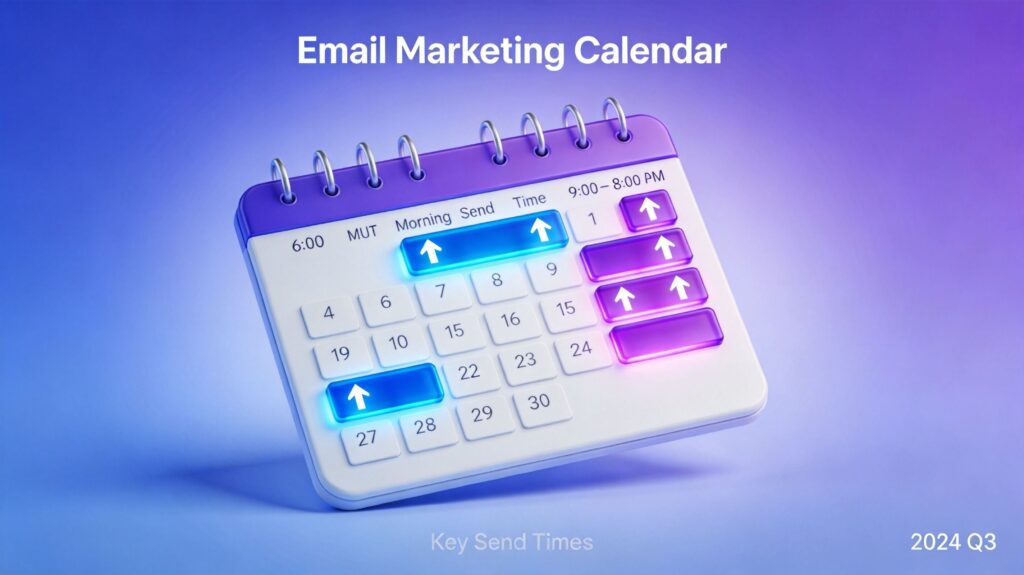
Sending everyone at 10 AM from your time zone means half your list gets emails at 4 AM. That kills engagement.
The rule: Always send in your recipient’s local time zone.
Most modern email platforms (like Kit, Mailchimp, and Klaviyo) handle this automatically. If your platform supports Timewarp or similar features, use them.
Pro tip: Your platform only knows time zones if your data is accurate. Poor list hygiene means poor timing. Keep your subscriber data clean and current.
Send Time Optimization: Let AI Do the Heavy Lifting
Here’s where 2025 email marketing gets exciting: AI-powered send time optimization.
nstead of guessing when your audience is active, AI analyzes each subscriber’s individual behavior—when they open, what device they use, how often they engage—and delivers your email at the moment that specific person is most likely to act.
Campaign Monitor found this approach increases open rates by 23% compared to static best-practice timing.
Platforms offering this:
- Kit (Send Time Optimization)
- Klaviyo (Smart Sending)
- Customer.io (Behavioral Triggers)
- ActiveCampaign (Predictive Sending)
If your email platform supports send time optimization, turn it on. It personalizes timing at scale—something impossible to do manually with large lists.
Industry Benchmarks: How Different Sectors Perform
Email engagement patterns vary by industry. Here are the 2025 benchmarks from MailerLite’s annual report:
Average metrics across industries:
- Open rate: 42-43%
- Click rate: 2.09%
- Click-to-open rate: 6.81%
But these vary significantly:
| Industry | Best Days | Best Times | Notes |
| Retail/E-commerce | Thu-Sun | Evening | Weekend shopping behavior |
| Healthcare | Tue-Thu | Early morning or late evening | Irregular schedules |
| Finance | Tue-Thu | 9-11 AM | Business hours alignment |
| Travel | Wed-Sat | Evening | Weekend trip planning |
| Education | Tue-Thu | Evening | Busy professionals |
| Tech/SaaS | Tue-Thu | 10 AM or 6 PM | Work-life balance |
Use these as starting points, but always test with your own data. Industry averages won’t beat your subscriber-specific insights.
How to Test Your Way to Optimal Send Times
Data gives you a starting point. Your own list gives you the truth.
A/B testing your send times:
- Test one variable at a time (day OR time, not both simultaneously)
- Run each test for at least 2-3 weeks (enough data to be meaningful)
- Use identical content (different timing only)
- Track both opens AND clicks (these often tell different stories)
- Segment your results (B2B vs B2C might need different times)
Example test: Send the same newsletter to Group A on Tuesday 10 AM and Group B on Thursday 6 PM. Compare open rates AND click rates. You might find Thursday evening gets more clicks even if Tuesday gets more opens.
The only send time study that matters is the one you run on your own list.

Best Practices Summary
Here’s your action checklist:
- Start with mid-week, mid-morning (Tuesday-Thursday, 10 AM) for general sends
- Switch to evening (6-9 PM) for action-oriented campaigns
- Always use recipient time zones (never your own)
- Enable AI send time optimization if your platform offers it
- Test, test, test — run A/B tests on your specific audience
- Match email type to timing — educational content vs. promotional
- Track the metrics that matter — opens, clicks, and conversions
Frequently Asked Questions
What is the best day to send marketing emails?
Tuesday, Wednesday, and Thursday consistently show the highest open rates across industries. Tuesday is the most popular choice, with 27% of marketers reporting it as their best day. However, for B2C or promotional emails, Thursday and Friday often perform well as people plan weekend activities.
Does morning really beat evening for email opens?
It depends on what you want. Morning sends (9-11 AM) typically get higher open rates because that’s when people check their inbox. However, evening sends (8-9 PM) often get higher click-through rates because people have time to actually read and act. Match your timing to your goal.
Should I send marketing emails on weekends?
Generally, no. Saturday and Sunday consistently show the lowest open and click-through rates for most industries. The exception: B2C brands targeting leisure shoppers, or if your specific audience data shows weekend engagement. Always test your own list.
How long should I test before deciding on a send time?
Run each variation for at least 2-3 weeks with enough volume to reach statistical significance. Small lists may need longer test periods. Focus on trends, not single-campaign results.
Does send time optimization really work?
Yes. AI-powered send time optimization analyzes individual subscriber behavior and delivers emails at personalized optimal times. Studies show this increases open rates by 23% compared to static best-practice timing.
What about time zones?
Always send in your recipient’s local time zone. Use tools like Timewarp (Mailchimp) or similar features in your email platform. Your timing data is only as good as your subscriber time zone data—keep your list clean and updated.
Conclusion
The best time to send marketing emails isn’t a single answer—it’s a strategy. Start with the data-backed basics: mid-week, mid-morning for opens; evening for clicks. But remember, your audience is unique.
The marketers winning in 2025 aren’t following generic advice. They’re testing their own lists, leveraging AI for personalization, and matching email type to optimal timing.
Your next step: Pick one variable to test this week. Tuesday 10 AM vs. Thursday 6 PM. Run it for two weeks. Let your data guide you.
The perfect send time exists for your list. You just have to find it.